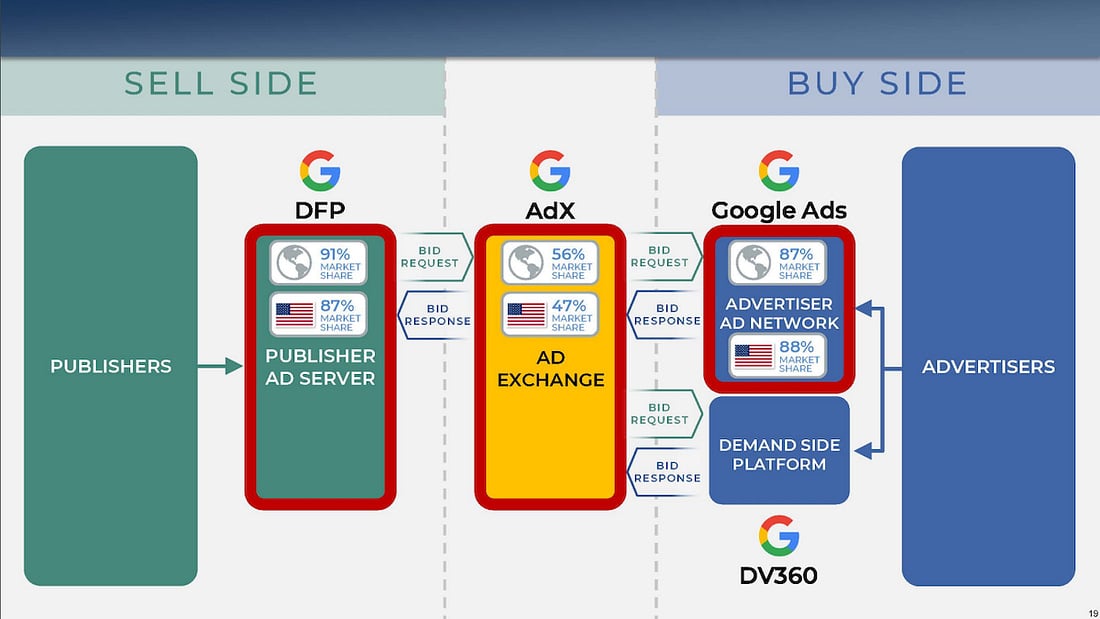
Dalla newsletter Big Tech on Trial:
The underlying structure of targeted internet advertising is completely different from the old days.
Instead of individual websites selling ad space, they hire a service to manage their space for them. This is a “publisher ad server,” and it has a large inventory of websites looking to sell space, which is why we’ll call it the “sell side” for short. On the “buy side” is an “advertiser ad network,” which similarly has a large inventory of advertisers looking for space to post ads. (Judge Brinkema found Google not liable for illegally monopolizing the buy side.)
In between the publisher ad server (the sell side) and the advertiser ad network (the buy side) is an “advertising exchange” which matches up ads with spaces by holding a lightning speed auction. In the time it takes a website to load after you click on it (maybe half a second), an ad exchange auctions off the advertising space on that webpage to the highest bidder among all the advertisers in the ad network inventories.
The three parts together are known as the “ad tech stack.” Companies compete to provide these services on the sell side, ad exchange, and buy side, and these are the three markets Google dominates with DFP, AdX, and Google Ads, respectively. Here’s what that all looks like visually: