Stop Using Conventional Commits. Ah, finalmente ho trovato il mio club. I conventional commit sono inutili nella maggior parte dei casi.
#git
Le stacked PR su GitHub sono in preview:
Arrange pull requests in an ordered stack and merge them all in one click. Each PR represents one focused layer of your change, reviewed independently and landed together.
The gh stack CLI makes it easy to create stacks, perform cascading rebases, push branches and create PRs, and navigate between layers — all from your terminal.
The Many Flavors of Ignore Files. Andrew Nesbitt illustra la sintassi dei file .gitignore, che è sempre una buona idea ripassare, e le differenze principali con altri formati come .dockerignore.
Radicle. Radicle is an open source, peer-to-peer code collaboration stack built on Git. Unlike centralized code hosting platforms, there is no single entity controlling the network. Repositories are replicated across peers in a decentralized manner, and users are in full control of their data and workflow.
Review your own git pull requests
When you create a pull request in GitHub, click on the Files changed tab, and scroll through the diff. Anywhere you’ve done something new that’s not already explained by in-code comments, add a comment in the GUI about what you did and why.
- Often, it’s stuff that’s not important enough for in-code commentary, but is useful for the reviewer to know.
- Sometimes, it’s stuff that should actually be documented in the code, and this is a good time to go back and add it.
- Every now and then, you’ll notice a bug in your own code because you’re reading it with fresh eyes, in a different format than your text editor.
It’s a simple behavior change that adds maybe 5 or 10 minutes to the time it takes to setup a PR, but it’s saved me so many headaches, and makes life for whoever reviews your PR a lot easier, too!
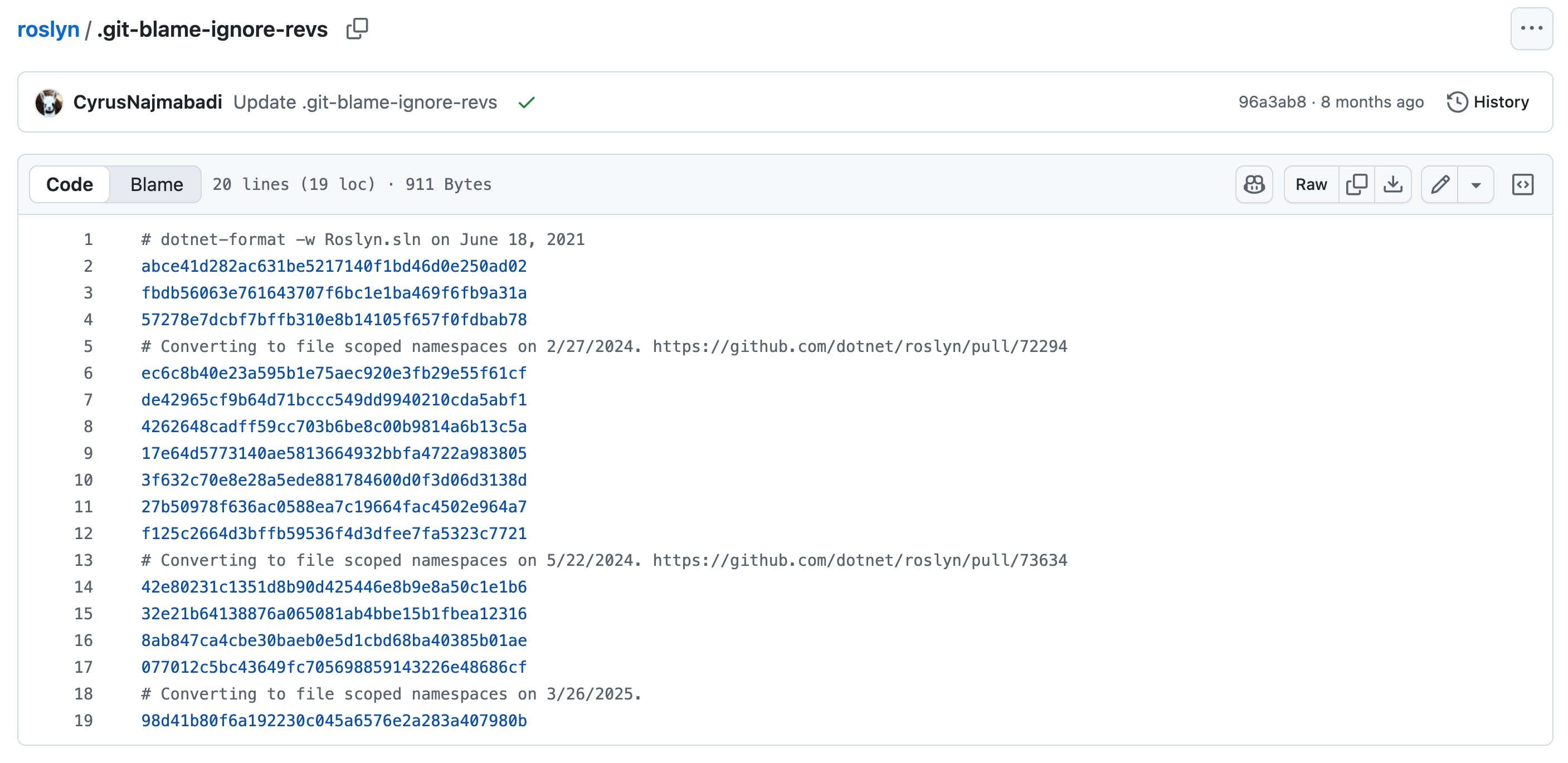
TIL con un file .git-blame-ignore-revs si possono ignorare determinati commit dall'output "blame" su GitHub (o con git blame --ignore-revs-file .git-blame-ignore-revs), utile quando si fanno refactoring o si modifica la formattazione ma non la funzionalità.
Archivio
- 2026
- settembre (28)
- agosto (25)
- luglio (22)
- giugno (32)
- maggio (29)
- aprile (67)
- marzo (55)
- febbraio (40)
- gennaio (54)
- 2025
- dicembre (79)
- novembre (63)
- ottobre (102)
- settembre (22)
Tag
- #ai (144)
- #dev (63)
- #cloud (57)
- #italia (56)
- #digitalizzazione (33)
- #mondo (31)
- #openai (31)
- #business (29)
- #security (26)
- #internet (23)
- #cdn (22)
- #database (21)
- #social (19)
- #reti (19)
- #cloudflare (18)
- #video (18)
- #google (16)
- #aws (16)
- #informazione (16)
- #claude (16)
- #domini (15)
- #browser (15)
- #mobilità (14)
- #storage (14)
- #macos (13)
- #anthropic (13)
- #github (12)
- #scrivere (12)
- #web-dev (12)
- #meta (10)
- #dns (9)
- #pagopa (9)
- #telegram (9)
- #design (8)
- #http (8)
- #email (7)
- #bending-spoons (7)
- #open-source (7)
- #codex (7)
- #git (6)
- #innovazione (6)
- #libri (6)
- #dataviz (6)
- #tlc (6)
- #amazon (6)
- #hetzner (5)
- #privacy (5)
- #ovh (5)
- #microsoft (5)
- #waymo (4)
- #antipirateria (4)
- #agenziadelleentrate (4)
- #streaming (4)
- #mistral (3)
- #app (3)
- #kubernetes (3)
- #whatsapp (3)
- #energia (3)
- #cie (3)
- #ipv6 (3)
- #apple (3)
- #opendata (3)
- #colori (2)
- #eu (2)
- #revolut (2)
- #windows (2)
- #datacenter (2)
- #mobile (2)
- #android (2)
- #javascript (2)
- #trenitalia (2)
- #fastmail (1)
- #broadcasting (1)
- #markdown (1)
- #blog (1)
- #postgres (1)
- #dotnet (1)
- #aruba (1)
- #tim (1)
- #clickhouse (1)
- #rai (1)
- #akamai (1)
- #linux (1)
- #legal (1)
- #redis (1)
- #tailscale (1)