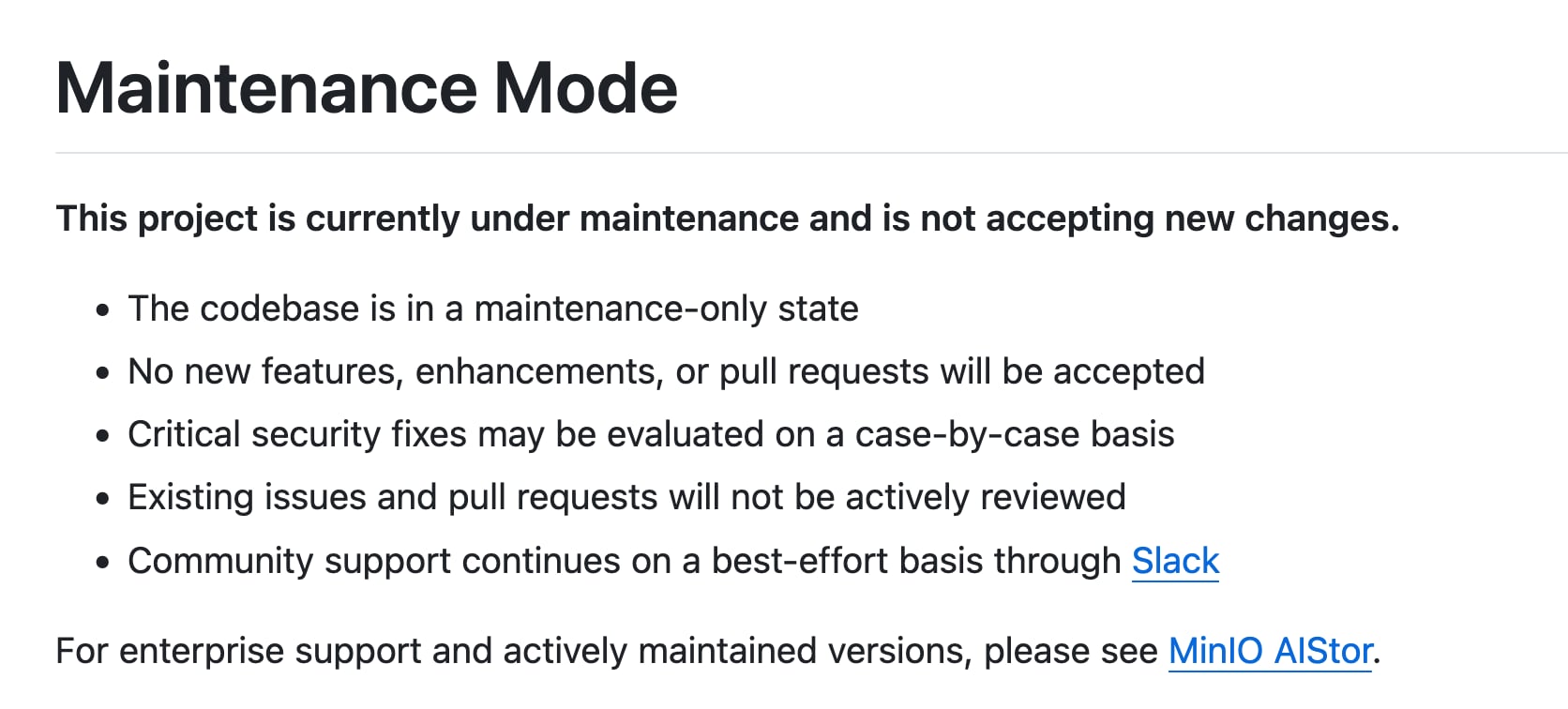
Altri feedback sulle alternative a MinIO, ora definitivamente abbandonato nella versione open source, da Hacker News.
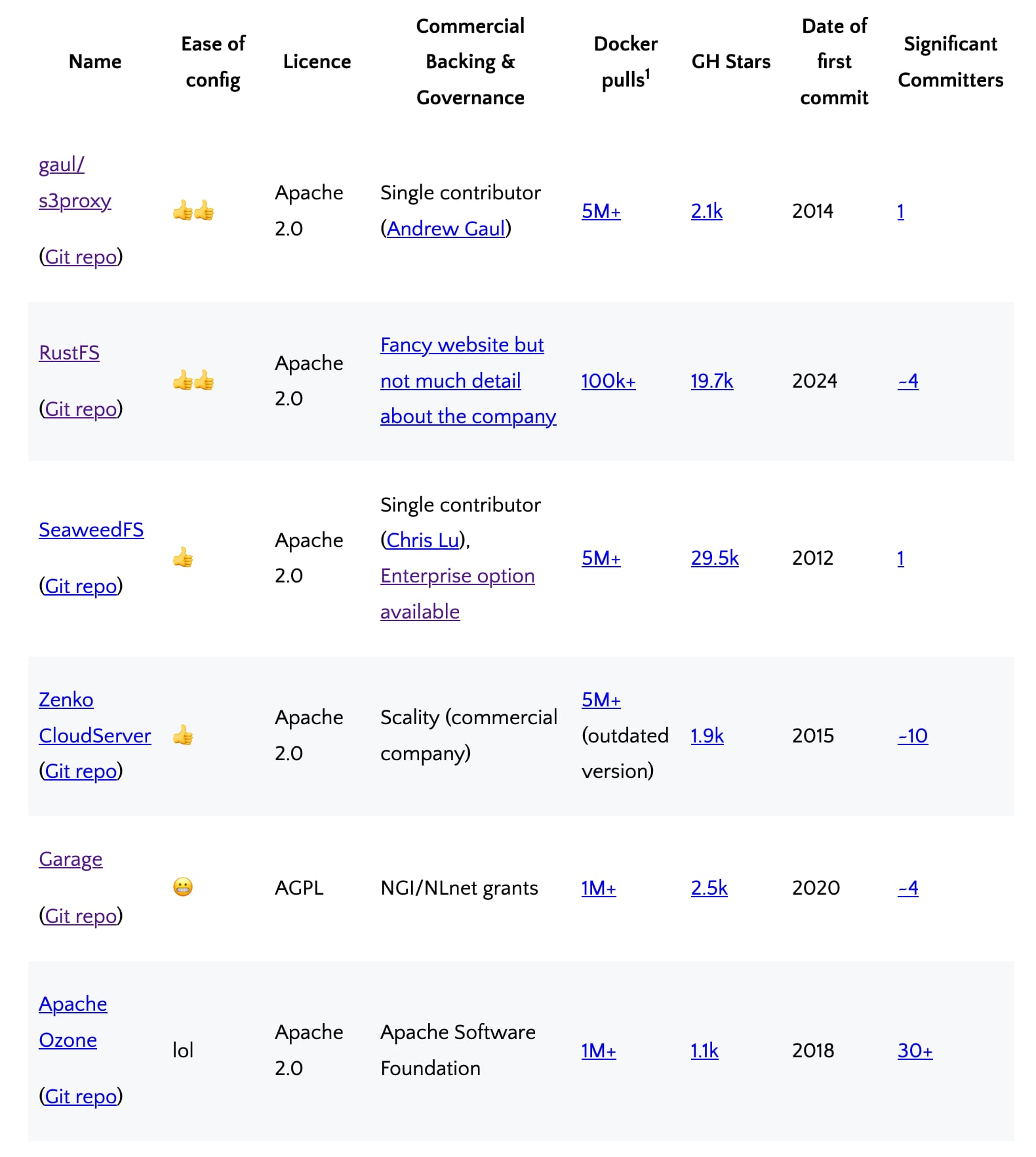
Un confronto tra le principali alternative (vedi anche miei post precedenti):
First off, I don't think there is anything wrong with MinIO closing down its open source. There are simply too many people globally who use open source without being willing to pay for it. I started testing various alternatives a few months ago, and I still believe RustFS will emerge as the winner after MinIO's exit. I evaluated Garage, SeaweedFS, Ceph, and RustFS. Here are my conclusions:
-
RustFS and SeaweedFS are the fastest in the object storage field.
-
The installation for Garage and SeaweedFS is more complex compared to RustFS.
-
The RustFS console is the most convenient and user-friendly.
-
Ceph is too difficult to use; I wouldn't dare deploy it without a deep understanding of the source code.
Although many people criticize RustFS, suggesting its CLA might be "bait," I don't think such a requirement is excessive for open source software, as it helps mitigate their own legal risks.
Furthermore, Milvus gave RustFS a very high official evaluation. Based on technical benchmarks and other aspects, I believe RustFS will ultimately win.
https://milvus.io/blog/evaluating-rustfs-as-a-viable-s3-compatible-object-storage-backend-for-milvus.md
Un po' di promozione dall'autore di SeaweedFS:
I work on SeaweedFS since 2011, and full time since 2025.
SeaweedFS was started as a learning project and evolves along the way, getting ideas from papers for Facebook Haystack, Google Colossus, Facebook Tectonics. With its distributed append-only storage, it naturally fits object store. Sorry to see MinIO went away. SeaweedFS learned a lot from it. Some S3 interface code was copied from MinIO when it was still Apache 2.0 License. AWS S3 APIs are fairly complicated. I am trying to replicate as much as possible.
Some recent developments:
-
Run "weed mini -dir=xxx", it will just work. Nothing else to setup.
-
Added Table Bucket and Iceberg Catalog.
-
Added admin UI